
Google Business Profile for Contractors: How to Show Up in the Map Pack
A homeowner in Marion needs a new driveway. They pull out their phone, type “concrete contractor near me,” and call one of the three companies in the map results. They almost never scroll.
If your company isn’t in those three results, you didn’t lose that job on price or on reputation. You lost it before anyone knew you existed.
That block of three businesses with the map above it is called the map pack, and for local construction work it’s the most valuable real estate in search. It sits above the regular blue links. On a phone, it often fills the entire first screen.
Here’s what actually decides whether you land there, and what most contractors get wrong.
Why the Map Pack Matters More for Contractors
The map pack is the group of three local listings Google shows for searches with local intent. It’s powered by your Google Business Profile, the free listing that holds your name, phone number, hours, photos, and reviews.
It matters more in construction than in most industries for one reason: nobody researches an emergency roof leak for a week. Someone searching “excavating company near me” is usually days from hiring, sometimes hours.
Two things follow. Map pack calls are worth more than general website traffic, because one call for a commercial site prep job can outweigh a month of blog visits. And your profile, not your website, is often the first impression.
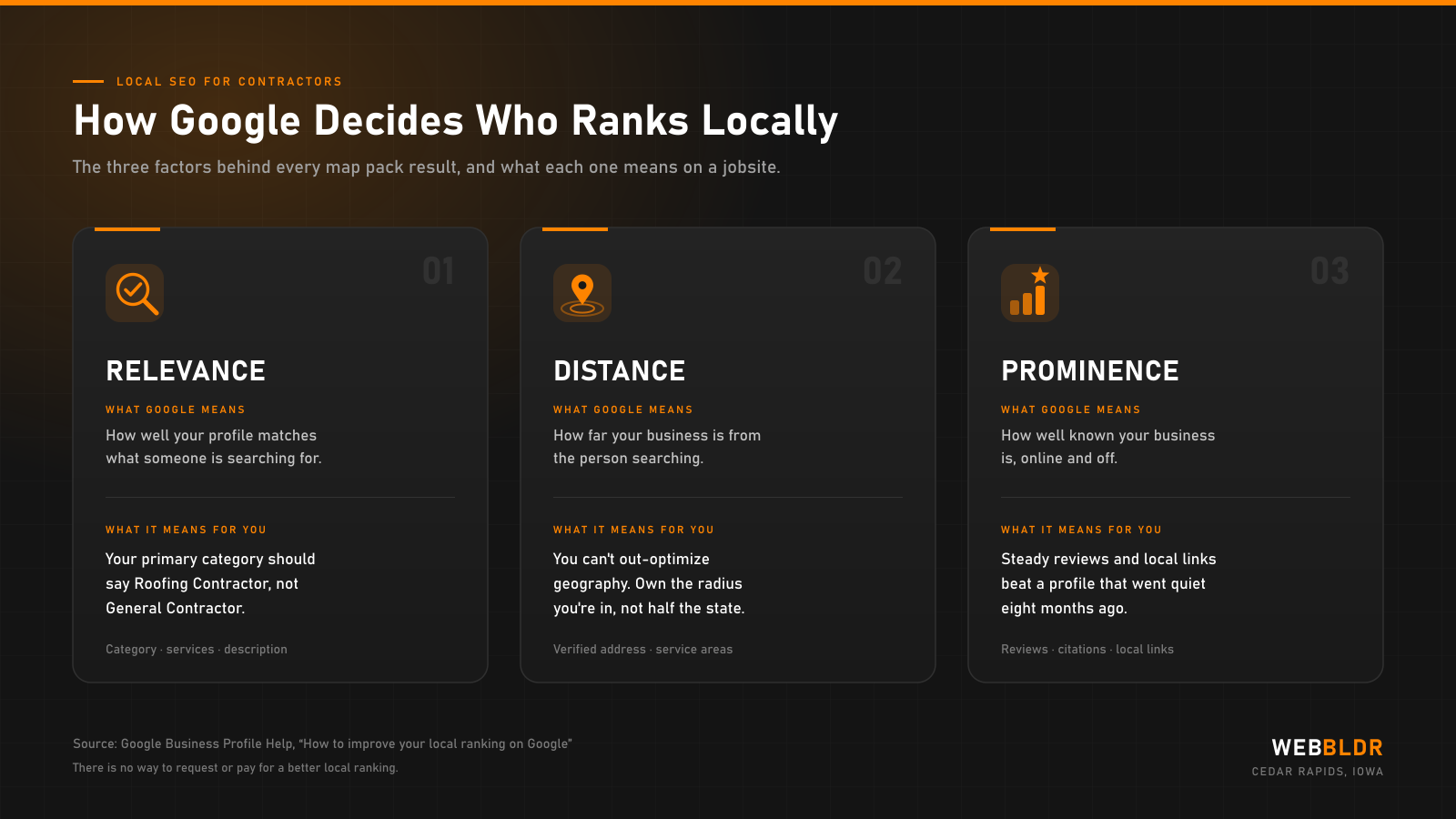
How Google Decides Who Ranks Locally
Google publishes this, and it’s worth knowing exactly, because a lot of contractor SEO advice contradicts it. According to Google’s documentation on local ranking, results come down to three things:
Relevance. How well your profile matches the search, based on your categories, services, description, website, and even the words in your reviews.
Distance. How far your business is from the searcher, or from the place they typed in.
Prominence. How well known your business is. Reviews, mentions across the web, and links to your site all feed this.
Google also states plainly that there’s no way to request or pay for a better local ranking. If someone offers to buy you a map pack position, walk away.
Here’s the translation:
Google’s factor | What it means for you | What you control |
|---|---|---|
Relevance | Does Google know you’re a masonry contractor, not a generic construction company?
| Primary category, services, description, website
|
Distance | How close your verified address is to the searcher
| Where you’re based, and how honestly you set your service area
|
Prominence | Do you look established and trusted?
| Reviews, citations, local links, sponsorships
|
Notice that distance is the one you can’t change. That fact reshapes everything else. You can’t out-optimize geography, but you can dominate the radius you’re actually in.
Set Up as a Service-Area Business the Right Way
Most contractors are what Google calls a service-area business. You go to the customer. Customers don’t come to your shop. This is where the most expensive mistakes happen.
Hide your address if customers don't visit you
If you run the business from home or from a yard where you don’t meet clients, Google requires you to hide the address. Leaving a home address visible is one of the most common causes of profile suspension, and reversing a suspension can take weeks you don’t have in build season.
Hiding the address does not remove distance as a ranking factor. Google still knows where you verified and still uses it. This trips people up constantly: they hide the address, see no change, and assume something broke. Nothing did.
Don't claim the whole state
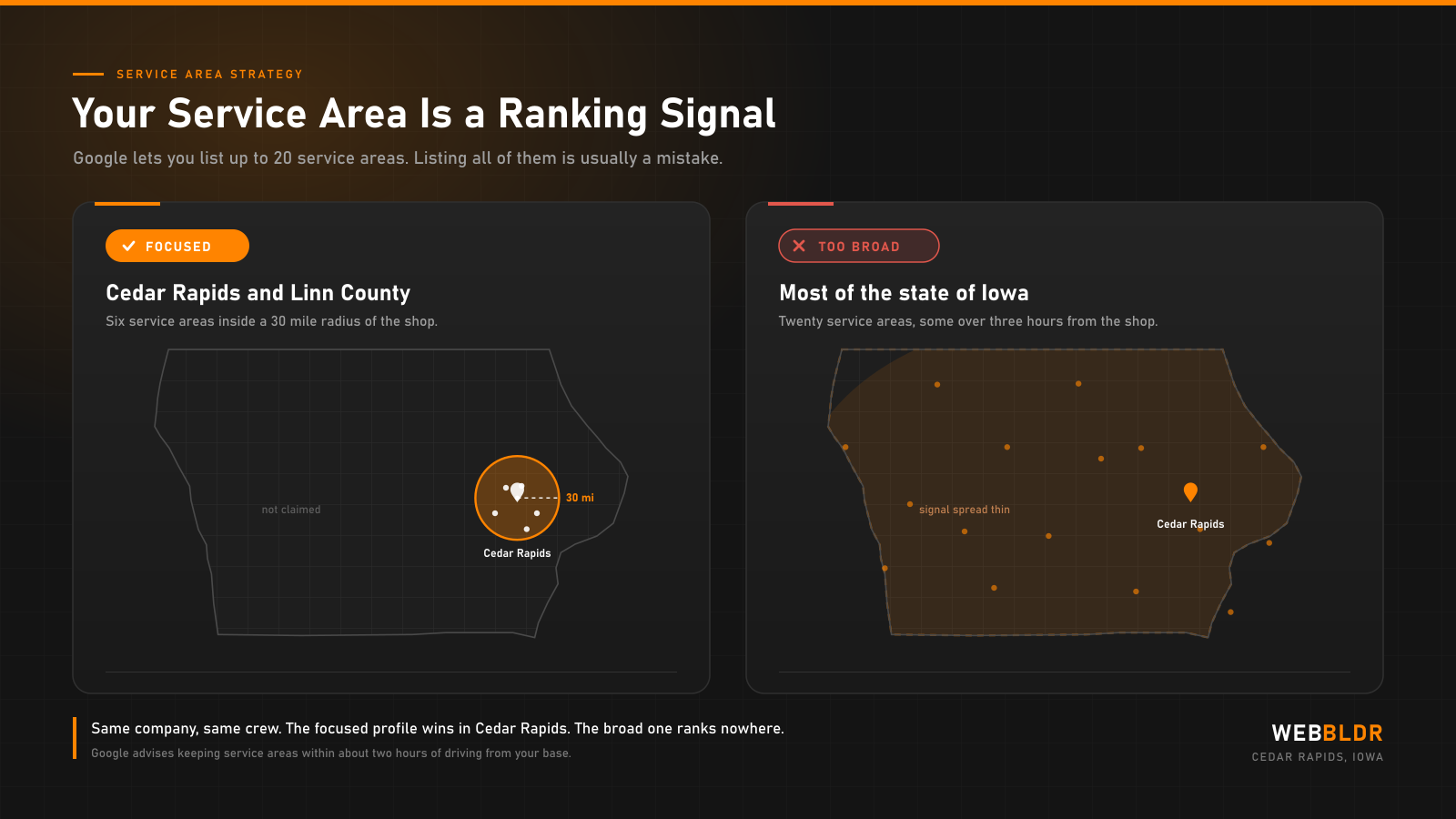
You can list up to 20 service areas, and Google advises that the outer edge shouldn’t be more than about two hours of driving from your base.
The temptation is to list every county you’d technically drive to. Resist it. Spreading yourself across half of Iowa dilutes the geographic signal that helps you win at home. A general contractor based in Cedar Rapids is far better off owning Cedar Rapids, Marion, Hiawatha, and Linn County than ranking nowhere across 40 towns.
A practical rule: list the places you’ve actually worked in the last two years and would happily bid tomorrow. For most small crews that’s five to ten entries, not twenty.
If you want work in Des Moines or Dubuque from a Cedar Rapids base, the answer isn’t a wider service area. It’s a real location there, or genuine location content on your site backed by projects you’ve completed in that market.
Pick the Right Categories
Your primary category carries more weight than almost anything else on the profile. If you’re a roofing company but your primary category says General Contractor, Google has a much weaker signal to show you for roofing searches.
Choose the category that describes your highest-value core service, not the broadest one.
If you are a… | Primary category | Secondary categories to consider |
|---|---|---|
Concrete contractor
| Concrete Contractor
| Paving Contractor, Construction Company |
Excavating company
| Excavating Contractor | Demolition Contractor, Grading Service
|
Roofing company
| Roofing Contractor
| Siding Contractor, Gutter Service
|
Masonry company
| Masonry Contractor
| Stone Supplier, Construction Company
|
Remodeling company
| Remodeler | Kitchen Remodeler, Bathroom Remodeler
|
Home builder
| Home Builder
| General Contractor, Construction Company
|
Landscaping company
| Landscaper | Landscape Designer, Lawn Care Service
|
Add secondary categories only for work you genuinely want. Padding the list with unrelated categories confuses your relevance signal instead of widening it.
One trade-off worth knowing: a general contractor that does everything is at a real disadvantage against specialists. A dedicated roofing company will usually beat a GC for “roofer near me.” If a service line drives serious revenue, it deserves its own deep page on your website, its own photos, and its own review requests.
Fill Out the Parts Everyone Skips
These take an afternoon, and most of your competitors haven’t done them.
Services. List each one separately with a short description. A concrete contractor should list stamped concrete, driveways, foundations, flatwork, and commercial concrete as distinct entries, not one line that says “concrete work.”
Business description. Write it for a homeowner or a project manager, not for Google. Say what you build, who you build it for, and where.
Hours. Keep them accurate, holidays included. Wrong hours generate bad reviews from people who called and got nothing.
Photos. This is where construction companies have a natural advantage and almost never use it. Most contractor profiles have four blurry phone shots. You have jobsites. Post finished projects, crews working, branded trucks, before-and-after pairs, and add new ones monthly rather than once at setup. Photos decide whether someone clicks your profile or the next one, and they separate an established outfit from a guy with a truck. If that gap is real for you, it’s exactly what professional photo, video, and drone work is for.
Q&A. You can ask and answer your own questions. Seed it with what you get on every call: do you give free estimates, how far out are you scheduling, are you licensed and insured. Leave it empty and a competitor may answer for you.
Reviews Are What Separate the Three From Everyone Else
Reviews feed prominence, and Google says directly that more reviews and positive ratings can help local ranking. They also decide which of the three listings actually gets the call.
Google remains the dominant place people read reviews, according to BrightLocal’s Local Consumer Review Survey, which also found only about 20% of consumers say reviews need to be from the last two weeks. You don’t need a firehose. You need a trickle that never stops, which is good news when a job takes three months.
Good intentions die in July, so build the ask into your process:
Pick the moment. Final walkthrough, while the customer is standing on their new patio. Not three weeks later when the invoice is the last thing they remember.
Respond to every one. Good and bad. Responses are visible to every future customer.
Your Website Still Has to Do Its Job
Google cross-references your profile against your site, and mismatches hurt.
Keep NAP consistent. Name, address, phone must match exactly across your website, profile, Facebook page, and every directory. Not “St.” in one place and “Street” in another.
Build service pages with depth. One page listing twelve services won’t rank for any of them. A page dedicated to commercial concrete, with real project photos and a description of your process, will.
Use project pages. This is the most underused asset in construction marketing. Every completed job is a page with location, scope, and photos. It builds relevance, geographic signal, and the thing prospects actually want to look at.
Chase local links. Your chamber of commerce, trade associations, supplier and manufacturer dealer pages, the youth team you sponsor. These beat any bulk directory package.
What to Expect, and Where to Start
Be skeptical of anyone promising a specific position by a specific date. Nobody controls Google’s rankings. Profile fixes can move views and calls within weeks. Meaningful movement on competitive searches usually takes three to six months, longer in dense metros.
Track profile views, calls, direction requests, and review count in your dashboard. Then track the number that pays the bills: quote requests that became jobs.
If you do nothing else this week, do three things. Fix your primary category. Trim your service areas to where you actually work. Text your last five customers a review link. That’s an hour, and it puts you ahead of most of your competition.
The rest, deep service pages, real project photography, and a review process that survives your busiest months, is a bigger lift. It’s also the part that compounds.
WEBBLDR works with contractors, excavators, concrete crews, roofers, and builders across Iowa on exactly this: profiles that get found, websites that turn visits into estimates, and jobsite photography that makes both look like the quality of your actual work. If you’re tired of watching competitors take calls that should have been yours, start a conversation with our team.
FAQ
Why is my construction company not showing up on Google Maps?
The most common causes are an unverified or suspended profile, a primary category that’s too generic, a service area spread too thin, or too few reviews compared to competitors. Distance also plays a large role, so a company based well outside a city will struggle to rank for searches inside it.
Do contractors need a physical address to rank on Google Maps?
You need a verified address, but not a storefront. If you don’t meet customers at your location, Google requires you to hide the address and operate as a service-area business. Your verified location still affects how close Google considers you to a searcher.
How many service areas should a contractor add to Google Business Profile?
Google allows up to 20, but using all of them is usually a mistake. List only the places you actively work and would bid in tomorrow. For most small and mid-sized crews that’s five to ten areas.
What is the best Google Business Profile category for a concrete contractor?
Concrete Contractor as the primary category. Add secondary categories such as Paving Contractor or Construction Company only if you genuinely offer those services. The primary category is the strongest relevance signal on the profile.
How many Google reviews does a contractor need?
There’s no fixed number. What matters is being competitive with the businesses currently ranking in your area, and having a steady flow rather than a burst. Check the review counts of the three listings in the map pack for your main search term and use that as your benchmark.
How long does local SEO take for a construction company?
Basic profile fixes can show effects within weeks. Meaningful movement in competitive local searches typically takes three to six months of consistent work, and longer in dense metro markets. Anyone guaranteeing a specific ranking by a specific date is not being straight with you.
Can I pay Google for a better local ranking?
No. Google states directly that there’s no way to request or pay for a better local ranking. You can pay for Local Services Ads or Google Ads, which appear above the map pack, but those are labeled ads and are separate from organic local rankings.